Ask or Tell: Balancing questions and instructions in intuitive teaching.
Abstract
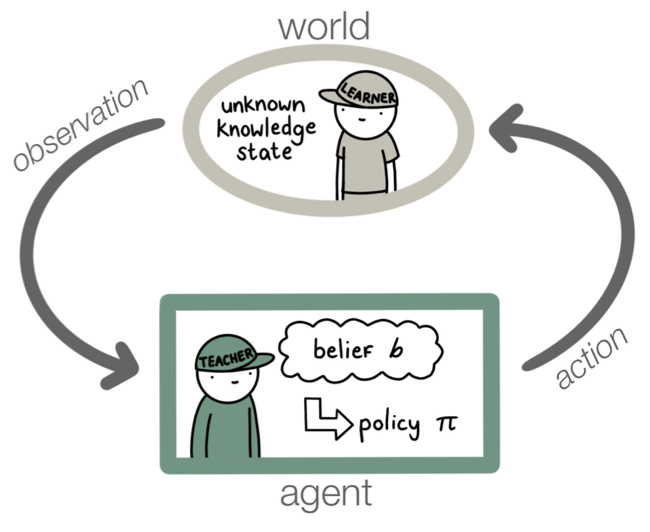
Teaching is an intuitive social activity that requires reasoning about and influencing the mind of others. A good teacher forms a belief about the knowledge of their student, asks clarifying questions, and gives instructions or explanations to try to induce a target concept in the student's mind. We propose Partially Observable Markov Decision Processes (POMDPs) as a model of intuitive human teaching. According to this account, teachers make pedagogical decisions with uncertainty about the knowledge state of their student. In two behavioral experiments, human participants were tasked with balancing assessments (asking questions) and instructions to help teach a student to build a tower of colored blocks. Human behavior in the task was compared to the performance of a computerized teaching algorithm optimized to solve the equivalent POMDP. Our results show that humans favor asking questions and establishing common ground during teaching even at an economic cost and increase question asking as uncertainty grows.
Highlighted Figures
Keywords
Bibtex entry:
@inproceedings{popp2020ask,
	abstract = {Teaching is an intuitive social activity that requires reasoning about and influencing the mind of others. A good teacher forms a belief about the knowledge of their student, asks clarifying questions, and gives instructions or explanations to try to induce a target concept in the student's mind. We propose Partially Observable Markov Decision Processes (POMDPs) as a model of intuitive human teaching. According to this account, teachers make pedagogical decisions with uncertainty about the knowledge state of their student. In two behavioral experiments, human participants were tasked with balancing assessments (asking questions) and instructions to help teach a student to build a tower of colored blocks. Human behavior in the task was compared to the performance of a computerized teaching algorithm optimized to solve the equivalent POMDP. Our results show that humans favor asking questions and establishing common ground during teaching even at an economic cost and increase question asking as uncertainty grows.},
	address = {Austin, TX},
	author = {Osborn Popp, P.J. and Gureckis, T.M.},
	booktitle = {Proceedings of the 42nd Annual Conference of the Cognitive Science Society},
	editor = {Denison, S. and Mack, M. and Xu, Y. and Armstrong, B.C.},
	publisher = {Cognitive Science Society},
	title = {Ask or Tell: Balancing questions and instructions in intuitive teaching.},
year = {2020}}QR Code:

Download SVG