Self-directed learning favors local, rather than global, uncertainty
Abstract
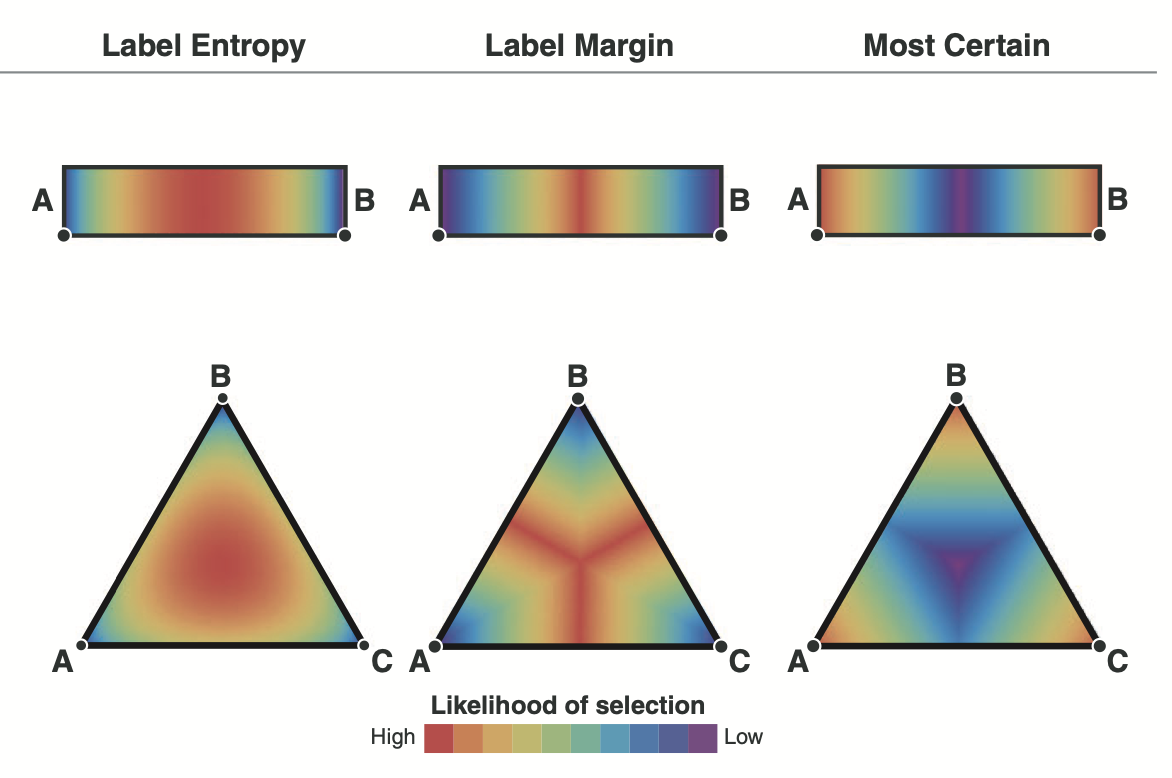
Collecting (or "sampling") information that one expects to be useful is a powerful way to facilitate learning. However, little is known about how people decide which information is worth learning about, particularly during the course of learning. We describe several alternative models of how people might decide to collect a piece of information inspired by "active learning" research in machine learning. We additionally provide a theoretical analysis demonstrating the situations under which these models are empirically distinguishable, and report a novel empirical study that exploits these insights. Our model-based analysis of participant's information gathering decisions reveal that people prefer to select items which resolve the uncertainty between two possibilities at a time rather than items that have high uncertainty across all relevant possibilities simultaneously. The results appear to challenge standard normative models of the value of information as well as accounts which argue that people are hamstrung by confirmation bias.
Highlighted Figures
Keywords
Bibtex entry:
@article{markant2016localglobal,
	abstract = {Collecting (or "sampling") information that one expects to be useful is a powerful way to facilitate learning. However, little is known about how people decide which information is worth learning about, particularly during the course of learning. We describe several alternative models of how people might decide to collect a piece of information inspired by "active learning" research in machine learning. We additionally provide a theoretical analysis demonstrating the situations under which these models are empirically distinguishable, and report a novel empirical study that exploits these insights. Our model-based analysis of participant's information gathering decisions reveal that people prefer to select items which resolve the uncertainty between two possibilities at a time rather than items that have high uncertainty across all relevant possibilities simultaneously. The results appear to challenge standard normative models of the value of information as well as accounts which argue that people are hamstrung by confirmation bias.},
	author = {Markant, D.B. B and Settles, Burr and Gureckis, T.M.},
	journal = {Cognitive science},
	number = {1},
	pages = {100--120},
	title = {Self-directed learning favors local, rather than global, uncertainty},
	volume = {40},
year = {2016}}QR Code:

Download SVG