Is it better to select or to receive? Learning via active and passive hypothesis testing
Abstract
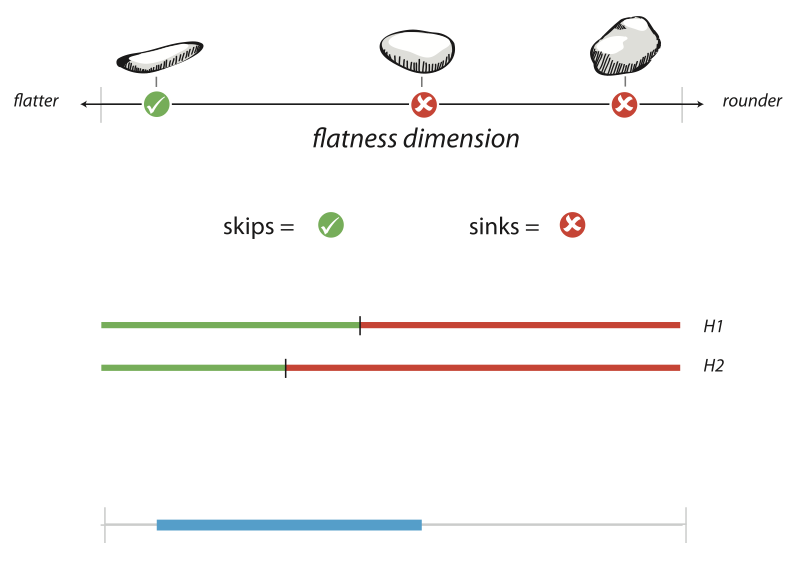
People can test hypotheses through either <i>selection</i> or <i>reception</i>. In a selection task, the learner actively chooses observations to test their beliefs, while in reception tasks data is passively encountered. People routinely use both forms of testing in everyday life, but the critical psychological differences between selection and reception learning remain poorly understood. One hypothesis is that selection learning improves learning performance by enhancing generic cognitive processes related to motivation, attention, and engagement. Alternatively, we suggest that differences between these two learning modes derives from a <i>hypothesis-dependent sampling bias</i> that is introduced when a person collects data to test their own individual hypothesis. Drawing on influential models of sequential hypothesis testing behavior, we show that such a bias 1) can lead to the collection of data that facilitates learning compared to reception learning, and 2) can be more effective than observing the selections of another person. We then report a novel experiment based on a popular category learning paradigm that compares reception and selection learning. We additionally compare selection learners to a set of ``yoked" participants who viewed the exact same sequence of observations under reception conditions. The results revealed systematic differences in performance that depended on the learner's role in collecting information and the abstract structure of the problem.
Highlighted Figures
Keywords
Bibtex entry:
@article{markant2014better,
	abstract = {People can test hypotheses through either <i>selection</i> or <i>reception</i>. In a selection task, the learner actively chooses observations to test their beliefs, while in reception tasks data is passively encountered. People routinely use both forms of testing in everyday life, but the critical psychological differences between selection and reception learning remain poorly understood. One hypothesis is that selection learning improves learning performance by enhancing generic cognitive processes related to motivation, attention, and engagement. Alternatively, we suggest that differences between these two learning modes derives from a <i>hypothesis-dependent sampling bias</i> that is introduced when a person collects data to test their own individual hypothesis. Drawing on influential models of sequential hypothesis testing behavior, we show that such a bias 1) can lead to the collection of data that facilitates learning compared to reception learning, and 2) can be more effective than observing the selections of another person. We then report a novel experiment based on a popular category learning paradigm that compares reception and selection learning. We additionally compare selection learners to a set of ``yoked" participants who viewed the exact same sequence of observations under reception conditions. The results revealed systematic differences in performance that depended on the learner's role in collecting information and the abstract structure of the problem.},
	author = {Markant, D.B. and Gureckis, T.M.},
	doi = {10.1037/a0032108},
	issn = {00963445},
	journal = {Journal of Experimental Psychology: General},
	keywords = {Bayesian modeling,Category learning,Hypothesis testing,Hypothesisdependent sampling bias,Self-directed learning},
	number = {1},
	pages = {94-122},
	title = {Is it better to select or to receive? Learning via active and passive hypothesis testing},
	volume = {143},
year = {2014}}QR Code:
Download SVG