Category Learning Through Active Sampling
Abstract
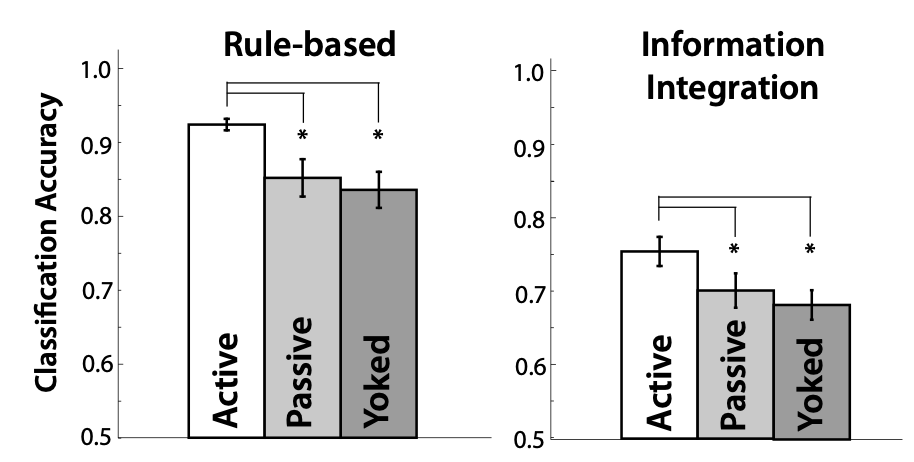
Laboratory studies of human category learning tend to emphasize <i>passive</i> learning situations by limiting participants' control over what information they experience on every trial. In this paper, we explore the impact that <i>active</i> data selection has on category learning. In our experiment, participants attempted to learn standard rule-based (RB) and information-integration (II) categories under either entirely passive (observational) conditions, or by actively selecting and querying the labels associated with particular stimuli. Our primary aim was to characterize the information sampling strategy that participants adopted in the task and to examine how the passive/active learning distinction interacted with the structure of the categories. We found that participants acquired categories faster when they were able to select and query category members on their own. Furthermore, this advantage depended on learners actually making the decisions about which stimuli to query themselves rather than simply the statistics of the experienced exemplars. Model based analyses explain this effect in terms of the number of active hypotheses under consideration which is assumed to be higher in the active learning condition due to the greater engagement of the learner in the task
Highlighted Figures
Keywords
Bibtex entry:
@inproceedings{markant2010category,
	abstract = {Laboratory studies of human category learning tend to emphasize <i>passive</i> learning situations by limiting participants' control over what information they experience on every trial. In this paper, we explore the impact that <i>active</i> data selection has on category learning. In our experiment, participants attempted to learn standard rule-based (RB) and information-integration (II) categories under either entirely passive (observational) conditions, or by actively selecting and querying the labels associated with particular stimuli. Our primary aim was to characterize the information sampling strategy that participants adopted in the task and to examine how the passive/active learning distinction interacted with the structure of the categories. We found that participants acquired categories faster when they were able to select and query category members on their own. Furthermore, this advantage depended on learners actually making the decisions about which stimuli to query themselves rather than simply the statistics of the experienced exemplars. Model based analyses explain this effect in terms of the number of active hypotheses under consideration which is assumed to be higher in the active learning condition due to the greater engagement of the learner in the task},
	address = {Austin, TX},
	author = {Markant, D.B. and Gureckis, T.M.},
	booktitle = {Proceedings of the 32nd Annual Conference of the Cognitive Science Society},
	editor = {Ohlsson, S. and Catrambone, R.},
	publisher = {Cognitive Science Society},
	title = {Category Learning Through Active Sampling},
year = {2010}}QR Code:

Download SVG