Broken Physics: A Conjunction-Fallacy Effect in Intuitive Physical Reasoning
Abstract
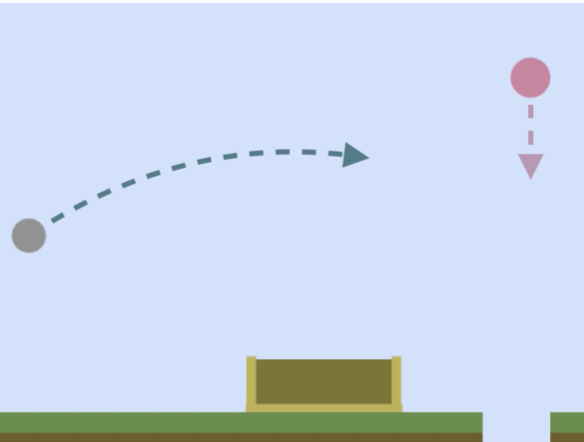
One remarkable aspect of human cognition is our ability to reason about physical events. This article provides novel evidence that intuitive physics is subject to a peculiar error, the classic conjunction fallacy, in which people rate the probability of a conjunction of two events as more likely than one constituent (a logical impossibility). Participants viewed videos of physical scenarios and judged the probability that either a single event or a conjunction of two events would occur. In Experiment 1 (n = 60), participants consistently rated conjunction events as more likely than single events for the same scenes. Experiment 2 (n = 180) extended these results to rule out several alternative explanations. Experiment 3 (n = 100) generalized the finding to different scenes. This demonstration of conjunction errors contradicts claims that such errors should not appear in intuitive physics and presents a serious challenge to current theories of mental simulation in physical reasoning.
Highlighted Figures
Keywords
Bibtex entry:
@article{ludwinpeery2020broken,
	abstract = {One remarkable aspect of human cognition is our ability to reason about physical events. This article provides novel evidence that intuitive physics is subject to a peculiar error, the classic conjunction fallacy, in which people rate the probability of a conjunction of two events as more likely than one constituent (a logical impossibility). Participants viewed videos of physical scenarios and judged the probability that either a single event or a conjunction of two events would occur. In Experiment 1 (n = 60), participants consistently rated conjunction events as more likely than single events for the same scenes. Experiment 2 (n = 180) extended these results to rule out several alternative explanations. Experiment 3 (n = 100) generalized the finding to different scenes. This demonstration of conjunction errors contradicts claims that such errors should not appear in intuitive physics and presents a serious challenge to current theories of mental simulation in physical reasoning.},
	author = {Ludwin-Peery, E. and Bramley, N. R. and Davis, E. and Gureckis, T.M.},
	doi = {10.1177/0956797620957610},
	eprint = {https://doi.org/10.1177/0956797620957610},
	journal = {Psychological Science},
	note = {PMID: 33137265},
	number = {12},
	pages = {1602-1611},
	title = {Broken Physics: A Conjunction-Fallacy Effect in Intuitive Physical Reasoning},
	url = {https://doi.org/10.1177/0956797620957610},
	volume = {31},
year = {2020}}QR Code:

Download SVG