Spontaneous mental restructuring in the Connections game
Abstract
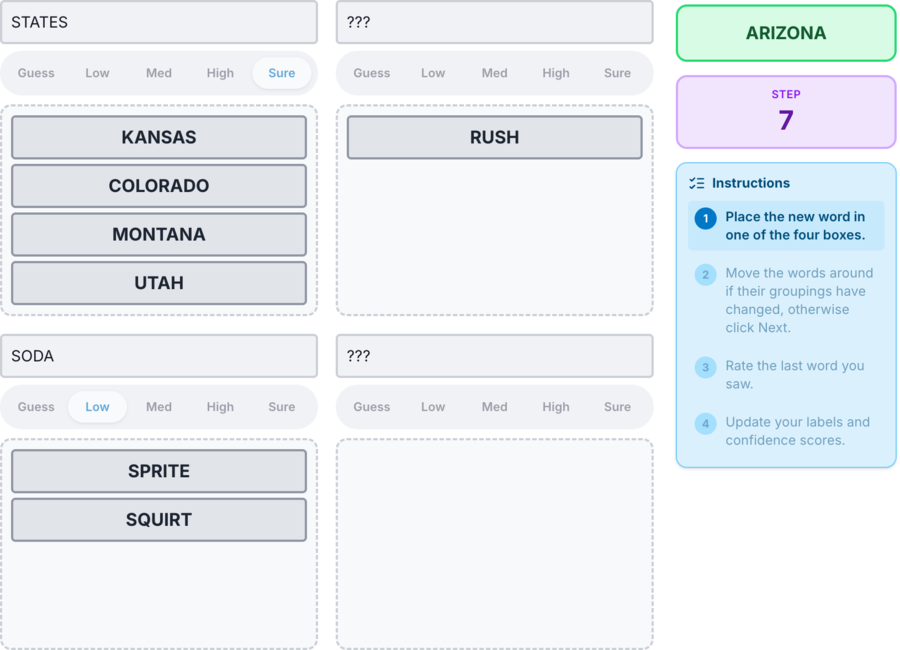
Insight is often theorized to arise from mental restructuring---abandoning an initial conceptual framework to adopt a new one. However, because of its covert nature, directly observing this process has proven difficult. We developed a modified version of the NYT Connections game, where participants organized sixteen sequentially-presented words into four categories. By manipulating word order, we induced ``semantic lures''---compelling but incorrect groupings---and varied whether participants received feedback after incorrect submissions. The order manipulation reliably modulated lure formation, but did not modulate insight reports on its own. A dissociation emerged at the level of individual trajectories: among participants who formed and then abandoned the lure, those who did so without any feedback reported insight credibly more often than those who restructured following an external error signal. Our proposed paradigm provides directly observable evidence that the ``aha'' experience tracks the trajectory of restructuring rather than simply reaching a solution.
Highlighted Figures
Keywords
Bibtex entry:
@inproceedings{legris2026connections,
	abstract = {Insight is often theorized to arise from mental restructuring---abandoning an initial conceptual framework to adopt a new one. However, because of its covert nature, directly observing this process has proven difficult. We developed a modified version of the NYT Connections game, where participants organized sixteen sequentially-presented words into four categories. By manipulating word order, we induced ``semantic lures''---compelling but incorrect groupings---and varied whether participants received feedback after incorrect submissions. The order manipulation reliably modulated lure formation, but did not modulate insight reports on its own. A dissociation emerged at the level of individual trajectories: among participants who formed and then abandoned the lure, those who did so without any feedback reported insight credibly more often than those who restructured following an external error signal. Our proposed paradigm provides directly observable evidence that the ``aha'' experience tracks the trajectory of restructuring rather than simply reaching a solution.},
	address = {Austin, TX},
	author = {LeGris, S. and Komischke, M. and Gureckis, T.M.},
	booktitle = {Proceedings of the 48th Annual Conference of the Cognitive Science Society},
	keywords = {insight; problem solving; games; reasoning},
	organization = {Cognitive Science Society},
	publisher = {Cognitive Science Society},
	title = {Spontaneous mental restructuring in the Connections game},
year = {2026}}QR Code:

Download SVG