Re-evaluating dissociations between implicit and explicit category learning: An event-related fMRI study
Abstract
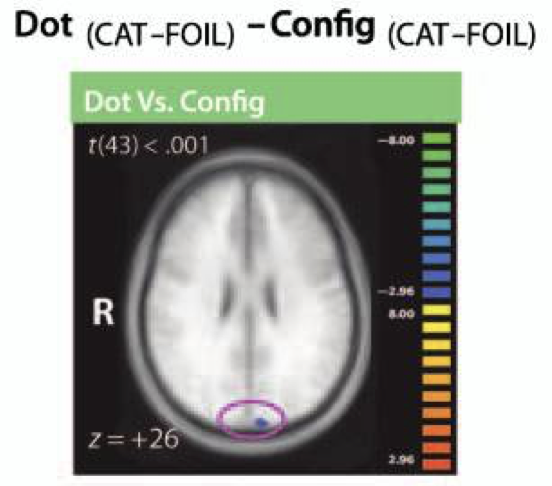
Recent functional magnetic resonance imaging (fMRI) studies have found that distinct neural systems may mediate perceptual category learning under incidental and intentional learning conditions. The present study was designed to replicate and extend previous investigations of these effects using an event-related design. In addition, the design is aimed at decoupling the influence of stimulus-encoding processes from the contribution of implicit and explicit learning on the recruitment of alternative neural systems. Consistent with previous reports, following incidental learning in a dot-pattern classification task, participants show decreased neural activity in occipital visual cortex (extrastriate region V3, BA 19) in response to novel exemplars of a studied category compared to members of a foil category, but do not show this decreased neural activity following explicit learning. Crucially, however, our results show that this pattern can be modulated by aspects of the stimulus-encoding instructions provided at the time of study. In particular, when participants in an implicit learning condition were encouraged to evaluate the overall shape and configuration of the stimuli during study, we failed to find the pattern of brain activity that has been taken to be a signature of implicit learning, suggesting that activity in this area does not uniquely reflect implicit memory for perceptual categories.
Highlighted Figures
Keywords
Bibtex entry:
@article{gureckis2011dissociations,
	abstract = {Recent functional magnetic resonance imaging (fMRI) studies have found that distinct neural systems may mediate perceptual category learning under incidental and intentional learning conditions. The present study was designed to replicate and extend previous investigations of these effects using an event-related design. In addition, the design is aimed at decoupling the influence of stimulus-encoding processes from the contribution of implicit and explicit learning on the recruitment of alternative neural systems. Consistent with previous reports, following incidental learning in a dot-pattern classification task, participants show decreased neural activity in occipital visual cortex (extrastriate region V3, BA 19) in response to novel exemplars of a studied category compared to members of a foil category, but do not show this decreased neural activity following explicit learning. Crucially, however, our results show that this pattern can be modulated by aspects of the stimulus-encoding instructions provided at the time of study. In particular, when participants in an implicit learning condition were encouraged to evaluate the overall shape and configuration of the stimuli during study, we failed to find the pattern of brain activity that has been taken to be a signature of implicit learning, suggesting that activity in this area does not uniquely reflect implicit memory for perceptual categories.},
	author = {Gureckis, T.M. and James, T.W. and Nosofsky, R.M.},
	journal = {Journal of Cognitive Neuroscience},
	number = {7},
	pages = {1697--1709},
	publisher = {MIT Press},
	title = {Re-evaluating dissociations between implicit and explicit category learning: An event-related fMRI study},
	volume = {23},
year = {2011}}QR Code:

Download SVG