A critical look at the mechanisms underlying implicit sequence learning
Abstract
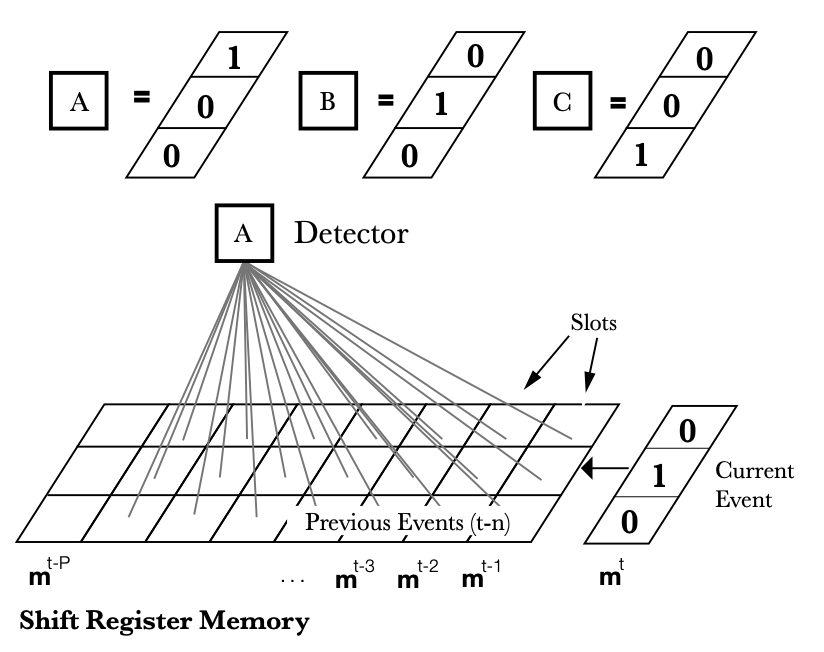
In this report, a model of human sequence learning is developed called the linear associative shift register (LASR). LASR uses a simple error-driven associative learning rule to incrementally acquire information about the structure of event sequences. In contrast to recent modeling approaches, LASR describes learning as a simple and limited process. We argue that this simplicity is a virtue in that the complexity of the model is better matched to the demonstrated complexity of human processing. The model is applied in a variety of situations including implicit learning via the serial reaction time (SRT) task and statistical word learning. The results of these simulations highlight commonalities between different tasks and learning modalities which suggest similar underlying learning mechanisms. LASR provides a similar account of the type of processing which underlies performance in both kinds of tasks, suggesting that they may rely on similar underlying mechanisms.
Highlighted Figures
Keywords
Bibtex entry:
@inproceedings{gureckis2005critical,
	abstract = {In this report, a model of human sequence learning is developed called the linear associative shift register (LASR). LASR uses a simple error-driven associative learning rule to incrementally acquire information about the structure of event sequences. In contrast to recent modeling approaches, LASR describes learning as a simple and limited process. We argue that this simplicity is a virtue in that the complexity of the model is better matched to the demonstrated complexity of human processing. The model is applied in a variety of situations including implicit learning via the serial reaction time (SRT) task and statistical word learning. The results of these simulations highlight commonalities between different tasks and learning modalities which suggest similar underlying learning mechanisms. LASR provides a similar account of the type of processing which underlies performance in both kinds of tasks, suggesting that they may rely on similar underlying mechanisms.},
	address = {Hillsdale, NJ},
	author = {Gureckis, T.M. and Love, B.C.},
	booktitle = {Proceedings of the 27th Annual Conference of the Cognitive Science Society},
	editor = {Bara, B. G. and Barsalou, L. and Bucciarelli, M.},
	publisher = {Lawrence Erlbaum Associates},
	title = {A critical look at the mechanisms underlying implicit sequence learning},
year = {2005}}QR Code:

Download SVG